What is Carson City known for? First and foremost our history and for being the state capital, in addition to our scenic beauty and outdoor recreation. Learn more about Carson City and Nevada’s history and the timeline of major milestones here in Carson City. See the right side navigation for more information and categories about Nevada’s history.
The History of Nevada – Dates and Events
1844 Explorer John C. Fremont travels through Western Nevada, including the future site of Carson City. He names the river flowing through the valley, the Carson River, after his scout, Kit Carson.
1851 Frank and Joseph Barnard, George Follensbee, Frank and W.L. Hall, and A.J. Rollins open a trading post at what today is the intersection of Thompson and Fifth streets. It is called “Eagle Station.”
1854 Admitted as part of Utah Territory.
1858 Abraham Curry, John J. Musser, Franklin Proctor, and Benjamin F. Green purchase 865 acres in Eagle Valley for $500 and a herd of horses. The four soon begin laying out a community, which Proctor names Carson City.
1861 Nevada Territory is created and Carson City is designated the territorial capital.
1864 Nevada gains statehood on October 31 and Carson City is selected as the state capital. Now a state holiday.
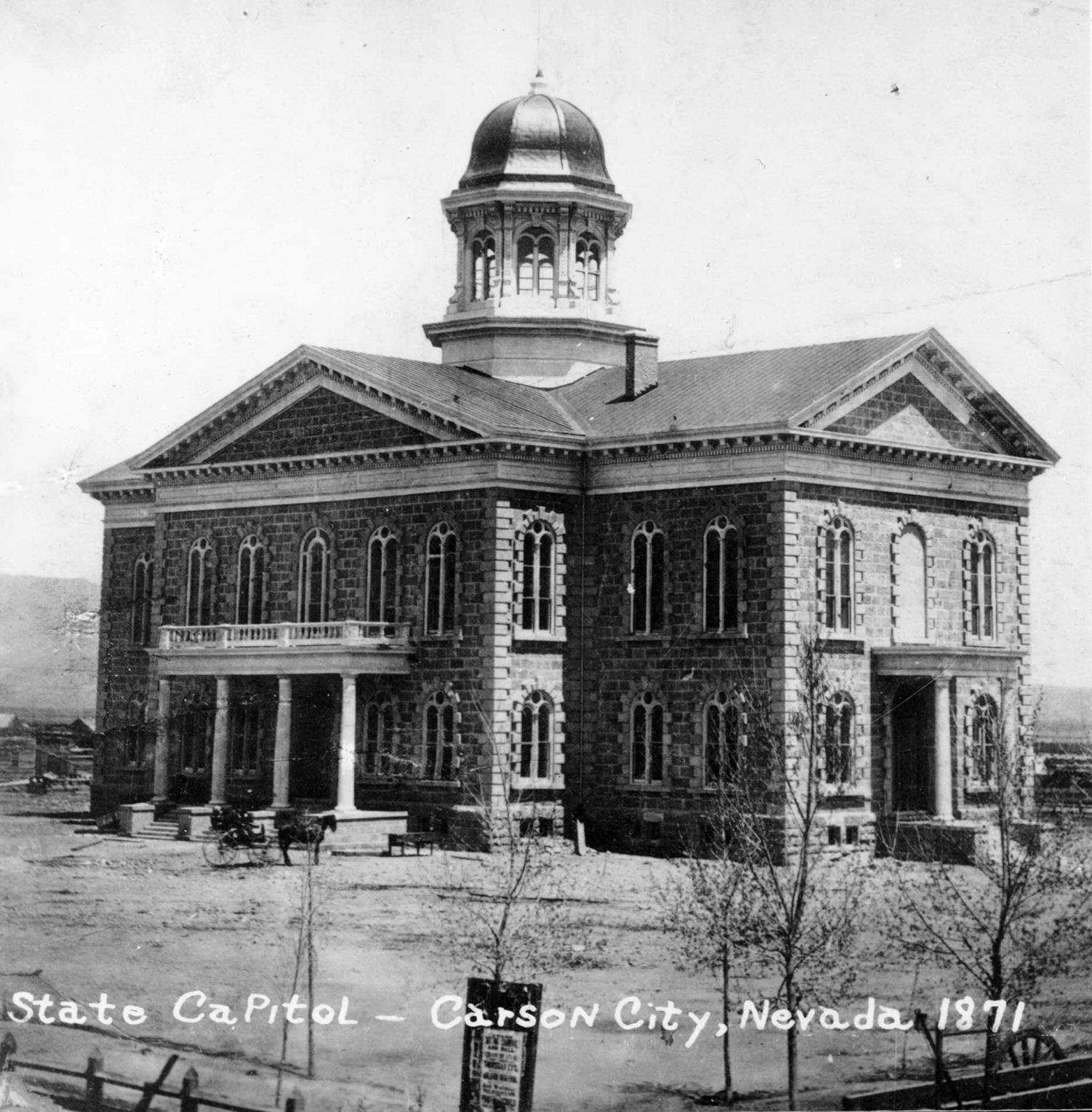
1871 The State Capitol building is completed.
1875 Carson City, Nevada is formally incorporated.
1897 World heavyweight championship fight between James “Gentleman Jim” Corbett and Australian Robert Fitzsimmons held in Carson City.
1909 The Governor’s Mansion, located on the corner of Robinson and Mountain, was completed.
1910 The first air flight in Nevada took place in Carson City on June 23, 1910. A Curtis biplane climbed 50 feet and traveled a distance of about a half mile in a field about three miles north of Carson City.
1911 A several-mile stretch of Carson Street is surfaced making it Carson City’s first paved road.
1919 The first trans-Sierra airplane flight landed in Carson City, Nevada on March 22, 1919. Three DeHavilands and a Curtis trainer landed in a field three miles east of Carson City. The flyers, who started at Mather Field in Sacramento, were welcomed by Governor Emmet Boyle, who flew with them on their return flight making him the first civilian to cross the Sierra by airplane.
1941 C.B. Austin became the first elected mayor of Carson City, Nevada.
1950 The last train of the original Virginia & Truckee Railroad completes its run from Reno to Minden.
1969 The Nevada State Legislature approved the consolidation of Ormsby County and Carson City into the state’s only combined city-county government.
1971 The 96,000 square-foot State Legislative Building was completed. It was expanded in 1997.
1986 Great Basin National Park, the only national park in the state, was created. It includes the area around Wheeler Peak and Lehman Caves in eastern Nevada.
Nevada Facts
First Settlement | A friendly debate exists between the towns of Dayton and Genoa, both near Carson City, and both settled in 1851. Dayton is the site of the first gold discovery in 1849.
Name | Adopted in 1861 when territory was established; from Spanish meaning “snow-capped.”
State Capital | Carson City, selected 1864.
State Flag | On a cobalt blue background; in the upper left quarter is a five-pointed silver star between two sprays of sagebrush crossed to form a half wreath; across the top of the wreath is a golden scroll with the words, in black letters, “Battle Born.” The name “Nevada” is beneath the star in gold letters. Design adopted March 26, 1929, revised in 1991.
State Seal | Adopted February 24, 1886. The seal has the words “The Great Seal of the State of Nevada” around the outer edge. Within this, is a composite picture showing the mining, agriculture, industry and scenery of Nevada, under which is the state motto, “All For Our Country.”
State Animal | The Desert Bighorn (or Nelson) Sheep (Ovis canadensis nelsoni) is smaller than its Rocky Mountain cousin but has a wider spread of horns. The bighorn is well-suited for Nevada’s mountainous desert country because it can survive for long periods without water. The large rams stand about 4-1/2 feet tall and can weigh as much as 175 pounds.
State Artifact | The Tule Duck was created by early Nevadans almost 2,000 years ago. Discovered by archaeologists in 1924 during an excavation at Lovelock Cave, the 11 decoys are each formed of a bundle of bullrush (tule) stems, bound together and shaped to resemble a canvasback duck.
State Bird | The Mountain Bluebird (Sialia currucoides) lives in the Nevada high country and destroys many harmful insects. It is a member of the thrush family and its song is a clear, short warble like the caroling of a robin. The male is azure blue with a white belly, while the female is brown with a bluish rump, tail, and wings.
State Colors | Silver and Blue
State Fish | The Lahontan Cutthroat Trout (Salmo clarki henshawi), a native trout found in 14 of the state’s 17 counties, is adapted to habitats ranging from high mountain creeks and alpine lakes to warm, intermittent lowland streams and alkaline lakes where no other trout can live.
State Flower | Sagebrush (Artemisia tridentata) grows abundantly in the deserts of the Western United States. A member of the wormwood family, sagebrush is a branching bush (1 to 12 feet high) and grows in regions where other kinds of vegetation cannot subsist. Known for its pleasant aroma, its gray-green twigs, and pale yellow flowers, sagebrush is an important winter food for sheep and cattle.
State Fossil | The Ichthyosaur (Shonisaurus) fossil was found in Berlin, east of Gabbs. Nevada is the only state to possess a complete skeleton (approximately 55 feet long) of this extinct marine reptile.
State Grass | Indian Ricegrass (Oryzopsis hymenoides), once a staple food source for Nevada Indians, now provides valuable feed for wildlife and range livestock. This tough native grass, which is found throughout the state, is known for its ability to reseed and establish itself on sites damaged by fire or over grazing.
State Metal | Silver
State Motto | “All For Our Country”
State Precious Gemstone | Among the many gemstones found in Nevada, the Virgin Valley Black Fire Opal is one of the most beautiful. The Virgin Valley in northern Nevada is the only place in North America where the Black Fire Opal is found in any significant quantity.
State Semi-precious Gemstone | Nevada Turquoise, sometimes called the “Jewel of the Desert,” is found in many parts of the state.
State Reptile | The Desert Tortoise (Gopherus agassizii), the largest reptile in the Southwestern United States, lives in the extreme southern parts of Nevada. Its hard, dome-shaped shell ranges from tan to black in color. This reptile spends much of its life in underground burrows to escape the harsh summer heat and winter cold. The desert tortoise can live to be more than 70 years old.
State Rock | Sandstone, in its more traditionally recognized form or as quartzite, is found throughout the state. In areas such as the Valley of Fire State Park and Red Rock Canyon Recreational Lands, both near Las Vegas, it provides some of Nevada’s most spectacular scenery. The State Capitol, and the former United States Mint, are built of sandstone.
State Song | “Home Means Nevada,” by Mrs. Bertha Raffetto of Reno, adopted February 6, 1933. “Home” means Nevada, “Home” means the hills, “Home” means the sage and the pines. Out by the Truckee’s silvery rills. Out where the sun always shines. There is a land that l love the best, Fairer than all I can see. Right in the heart of the golden west, “Home” means Nevada to me.
State Trees | The Single-Leaf Pinyon (Pinus monophylla) is an aromatic pine tree with short, stiff needles and gnarled branches. The tree grows in coarse, rocky soils and rock crevices. Though its normal height is about 15 feet, the single-leaf pinyon can grow as high as 50 feet under ideal conditions. The Bristlecone Pine (Pinus aristata) shares the state tree designation. The Bristlecone Pine is the oldest living thing on Earth, with some specimens in Nevada more than 4,000 years of age. The tree can be found at high elevations. Normal height for older trees is about 15 to 30 feet, although some have attained a height of 60 feet. Diameter growth continues throughout the long life of the tree, resulting in massive trunks with a few contorted limbs.
Did You Know? The combined city/county of Carson City is 146.9 square miles. The elevation of Carson City is 4,697 feet above sea level. Carson City is the only combined city-county government in Nevada. The population of Carson City is 55,274. The tallest point in Carson City limits is Snow Peak in the Sierra Nevada range, which rises 9,274 feet. Carson City’s first newspaper was the Territorial Enterprise, which had been started in 1858 in Genoa, then moved to Carson City a year later. In 1860, it moved to Virginia City, where it gained its greatest fame. Carson City’s first telephone line was strung in 1888. Carson City has an average yearly rainfall of 11.8 inches. Carson City has an average of 266 days of sunshine each year. The highest recorded temperature in Carson City was 103 degrees, reached on August 8, 1972. The lowest recorded temperature in Carson City was minus 18 degrees, reached on December 11, 1972. Major William Ormsby opened Carson City’s first commercial store in 1858.
Cinematic History
Movies Made in Carson City Historians believe that the first film shot in Carson City was footage of the “Gentleman” Jim Corbett vs. Bob Fitzsimmons prizefight in March 1897. During the next century, more than a dozen other movies have been at least partially filmed in the Capital City, including the following:
- A Little Journey Through Nevada (1918) Silent movie documentary includes a tour of historic sites in Carson City. The movie was made to promote Reno and Northern Nevada.
- Desperate Trails (1921)””Silent movie about an innocent convict who seeks revenge on those who sent him to jail starred Harry Carey. Exteriors of the Nevada State Prison appeared in the film.
- Pioneer Days of the West (1921) Documentary about Northern Nevada included a historic tour of Virginia City and Carson City with a ride on the Virginia & Truckee Railroad.
- The Remarkable Andrew (1942) Comedy about an accountant accused of embezzling who is aided by the ghost of Andrew Jackson starred William Holden. Filming took place in the Laxalt Building (Old Federal Building), the Rinckle House at 102 Curry St., and many other Carson City homes and businesses.
- Chicken Every Sunday (1949) This comedy about a woman looking back on her 20 years of marriage to an inept but loveable husband starred Celeste Holm and Dan Dailey. The south entrance to the State Capitol was used in the film.
- Roar of the Iron Horse (1950) Western about sabotage during the construction of a rail line through the west starred Jock Mahoney. The Virginia and Truckee Railroad’s routes in Carson City and Brunswick Canyon appeared in the movie.
- State Penitentiary (1950) Drama about a businessman mistakingly accused of embezzling starred Warner Baxter. Filmed at the Nevada State Prison.
- Train to Tombstone (1950) Western about a train robbery starred Don Barry and Robert Lowery. The Virginia and Truckee Railroad line in Carson City was used during filming.
- Deathwatch (1966) Historical film about a 1930s French prison starred Leonard Nimoy. The Nevada State Prison doubled as the French prison.
- A Howling in the Woods (1971) This made-for-television mystery about a woman haunted by strange noises was filmed in Genoa, Dayton, Glenbrook, and Carson City and starred Barbara Eden and Larry Hagman.
- The Shootist (1976) Classic western that was John Wayne’s last movie was filmed in Carson City’s historic district.
- Flesh and Blood (1979) Film about an ex-con who becomes a professional boxer starred Tom Berenger. Exteriors of the Nevada State Prison were used in the movie.
- Honkytonk Man (1982) This drama about an aging country singer dying of TB starred Clint Eastwood and his son, Kyle. The Brewery Arts Center was transformed into a nightclub for the film.
- An Innocent Man (1989) This drama about an innocent man framed by corrupt cops who seeks revenue when he is paroled from prison starred Tom Selleck. The Nevada State Prison was used extensively in the filming.
- Pink Cadillac (1989) This action/comedy about a good-hearted bounty hunter starred Clint Eastwood and Bernadette Peters. Fuji Park in Carson City was used for some of the filming.
- Misery (1990) This horror film about an obsessed fan that kidnaps a famous writer starred James Caan and Kathy Bates. Portions of the picture were filmed on Old U.S. 50 (Clear Creek Road) in Carson City.
- Sworn to Vengeance (1993) Drama about a policeman seeking vengeance for the murder of three teens starred Robert Conrad. Parts of the movie were filmed at the State Capitol and other sites in Carson City.
- Cobb (1994) This biopic about Baseball Hall of Famer Ty Cobb, who once lived at Lake Tahoe, starred Tommy Lee Jones and Robert Wuhl.
- Showgirls (1995) Drama about an ambitious exotic dancer determined to succeed as a Las Vegas showgirl starred Elizabeth Berkley and Kyle MacLachlan. Several scenes were filmed in Carson City.
- Trail of Tears (1995) Drama about two women seeking the return of their kidnapped children starred Katy Sagal and Pam Dawber. Much of the film was shot in Northern Nevada including Carson City.
- Feliz NaviDAD (2020) A Lifetime channel Christmas movie starring Mario Lopez. Shot downtown Carson City and in the homes on the Historic West Side.